Technical data · Brix Research Labs
Technical summaries for every compound we stock
Short, factual summaries of each research compound in our catalog, written for laboratory and procurement teams. Every product page also lists full technical data and links to the Certificate of Analysis for its current lot.
BPC-157
10 mg
BPC-157 is a synthetic 15-amino-acid peptide whose sequence is derived from a protein found in gastric juice. It is supplied as a lyophilized powder.
- CAS
- 137525-51-0
- MW
- 1419.5 g/mol
- Amino acids
- 15
- Formula
- C62H98N16O22
BRL-2TR
30 mg / 60 mg
BRL-2TR is a synthetic 39-residue lipidated peptide supplied as a lyophilized powder. It contains non-standard amino acids and a fatty-acid side chain.
- CAS
- 2023788-19-2
- MW
- 4813.5 g/mol
- Amino acids
- 39
- Formula
- C225H348N48O68
BRL-3RT
10 mg / 20 mg / 30 mg
BRL-3RT is a synthetic 39-residue lipidated peptide supplied by Brix Research Labs as a lyophilized powder. It contains non-standard amino acids and a fatty-acid side chain.
- CAS
- 2381089-83-2
- MW
- 4731.3 g/mol
- Amino acids
- 39
- Formula
- C221H342N46O68
CJC-1295/Ipamorelin (No DAC)
10 mg
CJC-1295/Ipamorelin (No DAC) is a research blend that combines CJC-1295 (No DAC) (5 mg), Ipamorelin (5 mg) in one vial, supplied as a lyophilized powder.
View CJC-1295/Ipamorelin (No DAC) →GHK-Cu
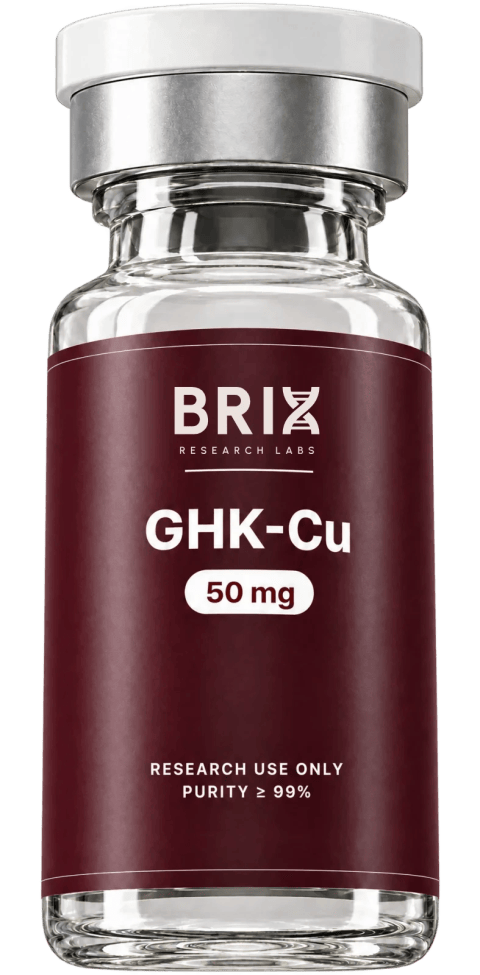
50 mg / 100 mg
GHK-Cu is the copper(II) complex of the naturally occurring tripeptide glycyl-L-histidyl-L-lysine (GHK). It is supplied as a lyophilized powder.
- CAS
- 89030-95-5
- MW
- 401.9 g/mol
- Amino acids
- 3
- Formula
- C14H22CuN6O4
Glutathione
1500 mg
Glutathione is the tripeptide gamma-L-glutamyl-L-cysteinylglycine in its reduced form. It is supplied as a lyophilized powder.
- CAS
- 70-18-8
- MW
- 307.3 g/mol
- Amino acids
- 3
- Formula
- C10H17N3O6S
KLOW
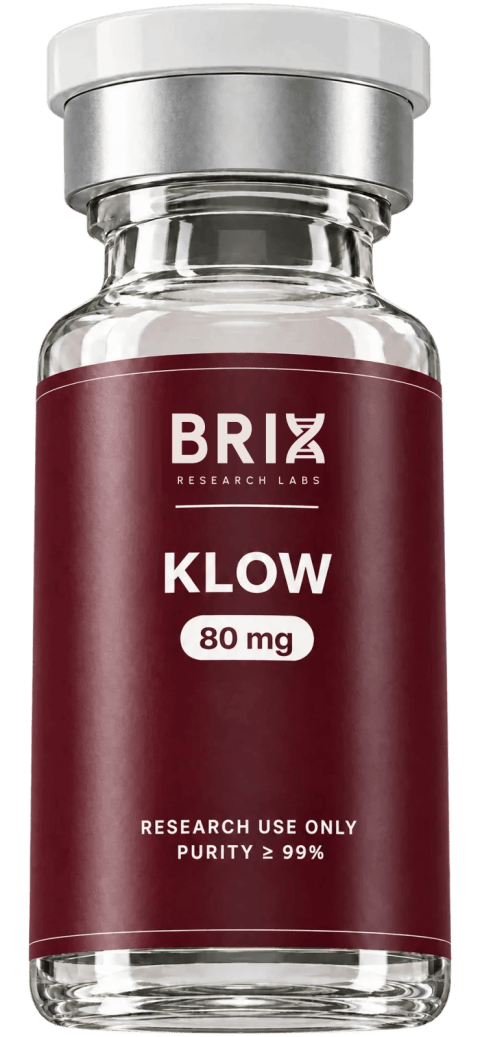
80 mg
KLOW is a research blend that combines GHK-Cu (50 mg), BPC-157 (10 mg), TB-500 (10 mg), KPV (10 mg) in one vial, supplied as a lyophilized powder.
View KLOW →KPV
10 mg
KPV is the tripeptide lysine-proline-valine, corresponding to the C-terminal residues 11–13 of alpha-melanocyte-stimulating hormone. It is supplied as a lyophilized powder.
- CAS
- 67727-97-3
- MW
- 342.4 g/mol
- Amino acids
- 3
- Formula
- C16H30N4O4
MOTS-C
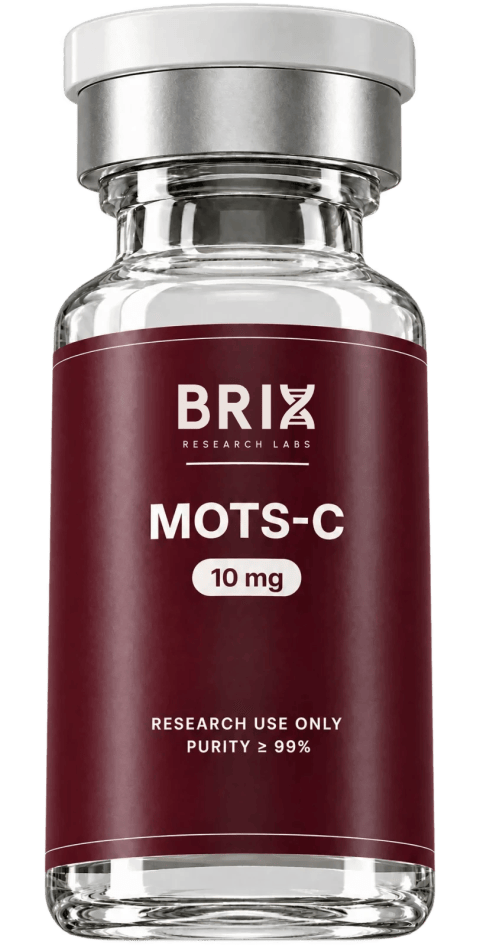
10 mg / 40 mg
MOTS-c is a 16-amino-acid peptide whose sequence is encoded in the mitochondrial genome, within the 12S rRNA region. It is supplied as a lyophilized powder.
- CAS
- 1627580-64-6
- MW
- 2174.6 g/mol
- Amino acids
- 16
- Formula
- C101H152N28O22S2
NAD+
500 mg
NAD+ (beta-nicotinamide adenine dinucleotide) is a dinucleotide coenzyme, not a peptide. It is supplied as a lyophilized powder.
- CAS
- 53-84-9
- MW
- 663.4 g/mol
- Formula
- C21H27N7O14P2
Research Water
10 mL
Research Water is bacteriostatic water: sterile water with 0.9% benzyl alcohol as a preservative, supplied in a sealed multi-draw vial for laboratory use.
View Research Water →SEMAX
10 mg
Semax is a synthetic heptapeptide (Met-Glu-His-Phe-Pro-Gly-Pro) based on the ACTH 4–7 fragment. It is supplied as a lyophilized powder.
- CAS
- 80714-61-0
- MW
- 813.9 g/mol
- Amino acids
- 7
- Formula
- C37H51N9O10S
Tesamorelin
10 mg
Tesamorelin is a synthetic 44-amino-acid analog of growth hormone–releasing hormone (GHRH 1–44) with a trans-3-hexenoyl group at the N-terminus. It is supplied as a lyophilized powder.
- CAS
- 218949-48-5
- MW
- 5135.9 g/mol
- Amino acids
- 44
- Formula
- C221H366N72O67S
Wolverine Blend
20 mg
Wolverine Blend is a research blend that combines BPC-157 (10 mg), TB-500 (10 mg) in one vial, supplied as a lyophilized powder.
View Wolverine Blend →For laboratory research use only. Not for human or animal consumption. Summaries describe the compounds’ chemistry only and are not product claims.
Research notes
Articles from the Research Library
- What Is NAD+? Structure and History of a Dinucleotide CoenzymeNicotinamide adenine dinucleotide is a coenzyme, not a peptide: how it is built, how it was discovered in 1906 and how labs test it.
- What Is Semax? Structure and History of an ACTH(4–7) PeptideA seven–amino acid peptide built from an ACTH fragment plus a stabilizing Pro-Gly-Pro tail: its structure, history and lab testing.
- What’s in KLOW? A Four-Part Research Blend ExplainedGHK-Cu, BPC-157, TB-500 and KPV in one vial: what each of the four compounds is and how a lab tests a blend with four parts.
- BPC-157 and TB-500: What Is in the Wolverine Blend?A 1:1 research blend of BPC-157 and TB-500 (thymosin β4): the structure and history of each compound and how a lab tests a two-part blend.
- What Is Tesamorelin? Structure and History of a GHRH AnalogA 44–amino acid synthetic analog of growth hormone–releasing hormone with one small chemical change at its start: its structure, history and testing.
- What Is MOTS-c? A Compound Encoded in Mitochondrial DNAA 16–amino acid compound encoded inside the mitochondrial 12S rRNA gene, first described in 2015: its sequence, discovery and how labs verify it.
- What Is GHK-Cu? Structure, History and Lab TestingThe copper complex of a three–amino acid chain first isolated from human plasma in 1973: its structure, history and how labs confirm what is in the vial.
- HPLC Purity Explained: What 99% Really MeansHow high-performance liquid chromatography works, how a purity percentage is calculated and what a 99% result does and does not tell you.
- How to Read a Certificate of Analysis (COA)A step-by-step guide to every part of a Certificate of Analysis: lot numbers, purity, identity, content and the red flags to watch for.