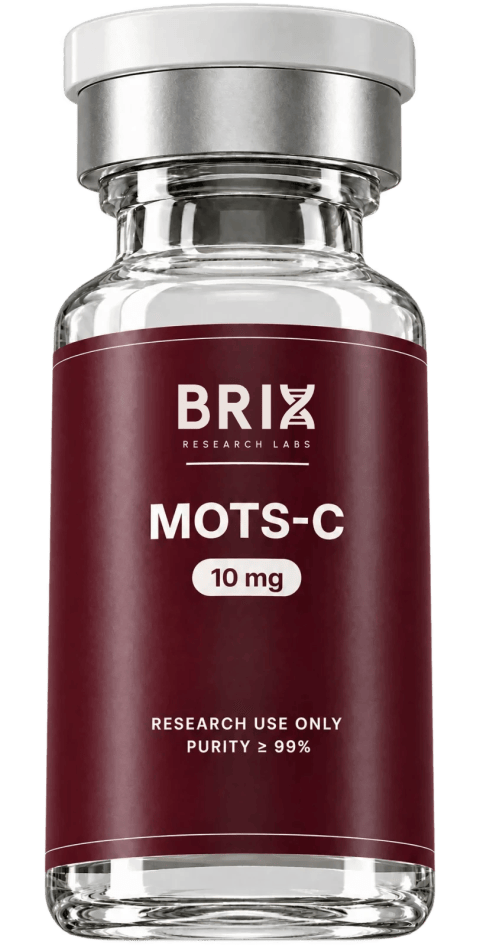
MOTS-c is a chain of 16 amino acids with an unusual origin: its instructions are written in the DNA of mitochondria, the tiny structures inside cells that carry their own small genome. It was first described in 2015 and is one of the newest compounds in laboratory research. This note explains what MOTS-c is, why its discovery surprised researchers and how a lab confirms a sample is genuine.
| Full name | Mitochondrial open reading frame of the 12S rRNA-c |
|---|---|
| CAS number | 1627580-64-6 |
| Sequence | MRWQEMGYIFYPRKLR |
| Molecular formula | C101H152N28O22S2 |
| Molecular weight | 2174.6 g/mol |
| Amino acids | 16 |
| Encoded by | Mitochondrial DNA, within the 12S rRNA gene (MT-RNR1) |
| Appearance | White lyophilized (freeze-dried) powder |
What the name means
MOTS-c is short for mitochondrial open reading frame of the 12S rRNA-c. Broken down:
- Mitochondrial: the instructions come from mitochondrial DNA, not the main DNA in the cell nucleus.
- Open reading frame: a stretch of genetic code that can be read as instructions for building an amino acid chain.
- 12S rRNA: the gene where that stretch was found. This gene’s main job is to make part of the mitochondria’s own protein-building machinery.
- c: the letter used to tell this reading frame apart from others the researchers examined.
Why the discovery was surprising
Human mitochondrial DNA is small, about 16,500 base pairs, and for decades it was thought to hold only 37 genes: 13 that code for proteins and 24 that make RNA molecules. The 12S rRNA gene was considered one of the RNA-only genes.
In 2015, Changhan Lee and colleagues in Pinchas Cohen’s laboratory at the University of Southern California reported in Cell Metabolism that a short reading frame hidden inside that gene encodes a 16–amino acid chain, which they named MOTS-c. It joined a small group of short chains encoded in mitochondrial DNA that researchers call MDPs, a family whose first member, humanin, was described in 2001. The finding helped show that mitochondrial DNA contains more coding information than its original 37-gene map suggested.
Reading the sequence
Each letter in MRWQEMGYIFYPRKLR is one amino acid. A few features matter in the lab:
- Two methionines (M) at positions 1 and 6. Methionine contains sulfur, which accounts for the S2 in the formula. It can also react with oxygen, so labs watch for an oxidized form that weighs 16 units more than the expected mass.
- Several arginines (R) and a lysine (K), which carry positive charges and make the chain dissolve well in water.
- Aromatic amino acids: tryptophan (W), tyrosine (Y) and phenylalanine (F). These absorb ultraviolet light, which helps detection during HPLC testing.
How labs check MOTS-c
- Purity by HPLC. Separates MOTS-c from shorter chains, missing–amino acid versions and oxidized forms, then reports the main compound as a percentage. See HPLC purity explained.
- Identity by mass spectrometry. The measured mass should match the expected 2174.6 g/mol. A signal 16 units higher points to methionine oxidation.
- Sequence confirmation. For extra certainty, some labs break the chain into fragments and check that the fragment masses match the expected sequence.
How Brix tests every lot
Every lot of MOTS-c we sell is tested by an independent U.S. laboratory before release. Each lot goes through seven quality checks, including purity by HPLC and identity, and is released only at 99% purity or higher. The signed Certificate of Analysis is posted in our COA Library and matched to the lot number on your vial. See how to read a Certificate of Analysis.
Lyophilized research compound, independently tested, with a signed COA for every lot.
Frequently asked questions
What does MOTS-c stand for?
Mitochondrial open reading frame of the 12S rRNA-c. The name describes where its genetic instructions are found: a short reading frame inside the 12S rRNA gene of mitochondrial DNA.
How many amino acids are in MOTS-c?
Sixteen. The sequence is MRWQEMGYIFYPRKLR.
What is the molecular weight of MOTS-c?
2174.6 g/mol, with the molecular formula C101H152N28O22S2. Its CAS number is 1627580-64-6.
When was MOTS-c discovered?
It was first reported in 2015 by Changhan Lee and colleagues at the University of Southern California, in the journal Cell Metabolism.
Is MOTS-c sold for human use?
No. Brix Research Labs supplies MOTS-c for laboratory research use only. It is not for human or animal consumption.
Sources
- Lee C, Zeng J, Drew BG, et al. Cell Metabolism. 2015;21(3):443–454. PubMed
- PubChem: MOTS-c, National Center for Biotechnology Information.
For laboratory research use only. Not for human or animal consumption. This note describes the chemistry and history of the compound and is not a product claim.