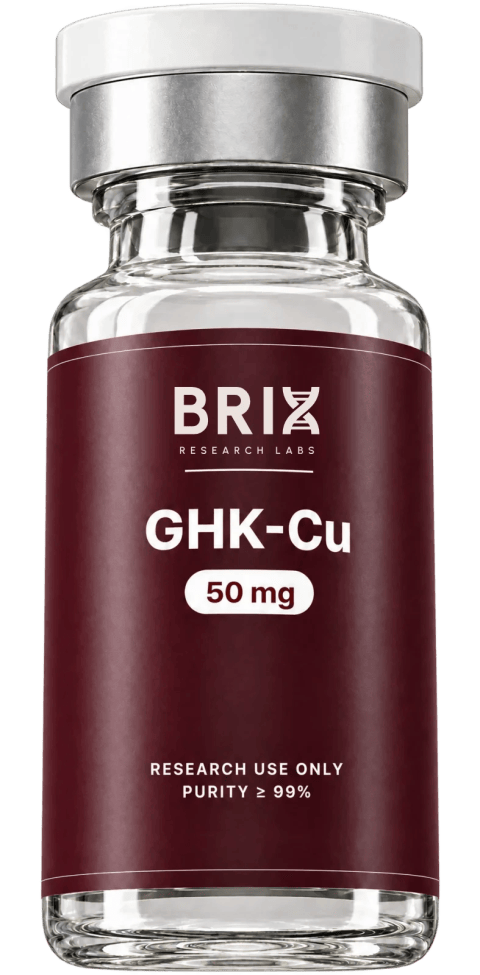
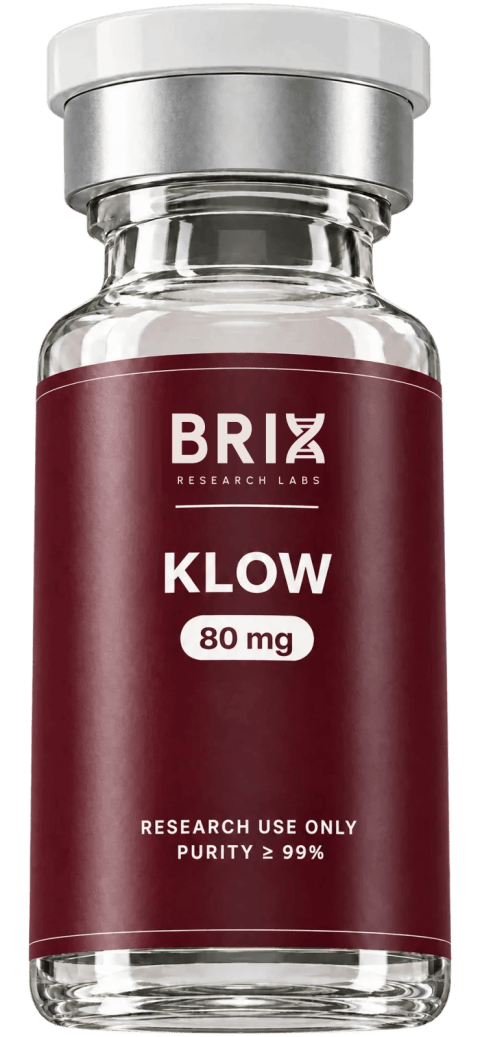
KLOW is a research blend that puts four compounds in one vial: GHK-Cu, BPC-157, TB-500 and KPV. It is one of the more complex products in the Brix catalog, because every one of those four compounds has to be confirmed, checked for purity and measured. This note walks through each part and explains how a four-part blend is tested.
| Compound | Amount | Amino acids | Molecular weight | CAS |
|---|---|---|---|---|
| GHK-Cu | 50 mg | 3 + copper | 401.9 g/mol | 89030-95-5 |
| BPC-157 | 10 mg | 15 | 1419.5 g/mol | 137525-51-0 |
| TB-500 (thymosin β4) | 10 mg | 43 | 4963.5 g/mol | 77591-33-4 |
| KPV | 10 mg | 3 | 342.4 g/mol | 67727-97-3 |
| Total | 80 mg |
The four compounds
GHK-Cu
GHK-Cu is a chain of three amino acids (glycine, histidine and lysine) holding one copper ion. It was first isolated from human plasma in 1973, and its copper gives the powder a blue color. It makes up the largest share of KLOW at 50 mg per vial. Read the full note: What is GHK-Cu?
BPC-157
BPC-157 is a synthetic chain of 15 amino acids (GEPPPGKPADDAGLV) whose sequence matches part of a protein found in human gastric juice. It was first described in 1993 by researchers at the University of Zagreb in Croatia.
TB-500
TB-500 is synthetic thymosin β4, a 43–amino acid protein that cells use to hold single units of actin, the protein behind the cell’s internal scaffolding. Its sequence was reported in 1981. Brix uses the full 43–amino acid version. BPC-157 and TB-500 are covered in more detail in BPC-157 and TB-500: what is in the Wolverine Blend?
KPV
KPV is the smallest compound in the blend: just three amino acids, lysine (K), proline (P) and valine (V). These are the last three amino acids of alpha-melanocyte–stimulating hormone (α-MSH), a 13–amino acid signaling molecule, which is why KPV is sometimes written as α-MSH (11–13). Its formula is C16H30N4O4.
How a four-part blend is tested
A single compound needs one purity number and one identity check. A blend like KLOW needs those for every component, plus proof that each one is there in the right amount.
- Separating the four. HPLC pushes the sample through a column, and each compound comes out at its own time based on its size and chemistry. A clean KLOW chromatogram shows four main peaks with very little in between. See HPLC purity explained.
- Telling look-alikes apart. GHK without its copper weighs 340.4 g/mol and KPV weighs 342.4 g/mol, only two units apart. Mass spectrometry alone could confuse them, but HPLC separates them first, and the copper in GHK-Cu adds a clear mass and color difference.
- Confirming each identity. Mass spectrometry checks that each peak has the mass of the compound it should be.
- Checking the amounts. Each peak is compared against a reference standard of known amount to confirm the 50 / 10 / 10 / 10 mg split.
- Color as a quick check. Because GHK-Cu makes up most of the blend, a KLOW vial should look blue.
How Brix tests every lot
Every lot of KLOW is tested by an independent U.S. laboratory before release. Each lot goes through seven quality checks, including purity by HPLC and identity, and is released only at 99% purity or higher. The signed Certificate of Analysis is posted in our COA Library, matched to the lot number on your vial. See how to read a Certificate of Analysis.
GHK-Cu, BPC-157, TB-500 and KPV in one lyophilized vial, independently tested, with a signed COA for every lot.
Frequently asked questions
What is in KLOW?
Four research compounds in one vial: 50 mg of GHK-Cu and 10 mg each of BPC-157, TB-500 and KPV, for 80 mg in total.
What is KPV?
KPV is a chain of three amino acids (lysine, proline, valine). It matches the last three amino acids of alpha-melanocyte–stimulating hormone and has a molecular weight of 342.4 g/mol.
Why is KLOW blue?
GHK-Cu, the largest component, contains copper(II), which gives the powder a blue color.
How do you test a blend with four compounds?
HPLC separates the four compounds into separate peaks, mass spectrometry confirms the identity of each one, and comparison against reference standards confirms the amount of each.
Is KLOW sold for human use?
No. Brix Research Labs supplies KLOW for laboratory research use only. It is not for human or animal consumption.
Sources
- PubChem: KPV (Lys-Pro-Val), GHK-Cu and BPC-157, National Center for Biotechnology Information.
- Low TLK, Hu SK, Goldstein AL. Proceedings of the National Academy of Sciences. 1981;78(2):1162–1166.
For laboratory research use only. Not for human or animal consumption. This note describes the chemistry and history of the compounds and is not a product claim.