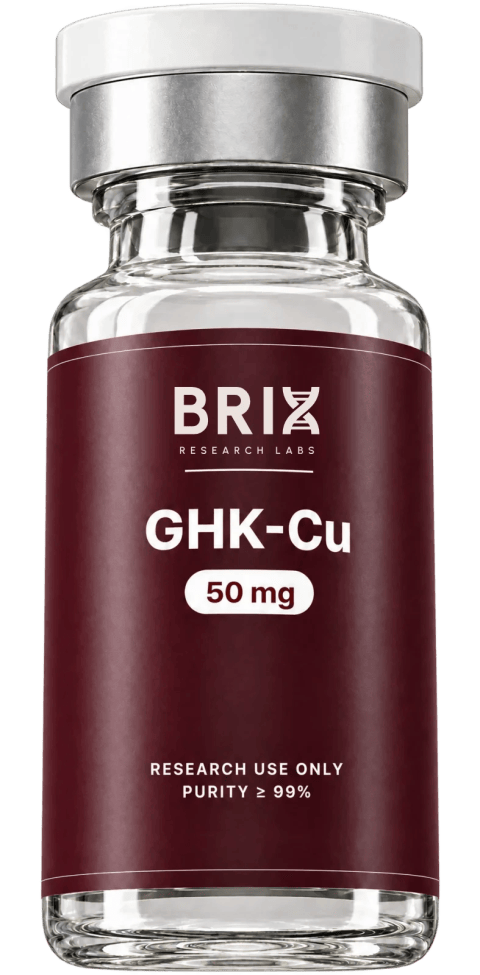
GHK-Cu is a small compound made of three amino acids (glycine, histidine and lysine) holding a single copper ion. It was first isolated from human plasma in 1973 and has since become one of the most widely studied copper complexes in laboratory research. This note covers what GHK-Cu is made of, where it came from and how a lab confirms that a sample matches its label.
| Full name | Glycyl-L-histidyl-L-lysine copper(II) complex |
|---|---|
| Short names | GHK-Cu, copper GHK |
| CAS number | 89030-95-5 |
| Molecular formula | C14H22CuN6O4 |
| Molecular weight | 401.9 g/mol (GHK without copper: 340.4 g/mol) |
| Amino acids | 3 (Gly-His-Lys) |
| Appearance | Blue to blue-violet lyophilized (freeze-dried) powder |
What GHK-Cu is made of
Amino acids are the building blocks that link together into chains. GHK is one of the shortest chains possible: just three amino acids joined end to end. The letters in the name are the standard one-letter codes for each one:
- G for glycine, the simplest amino acid
- H for histidine, whose ring-shaped side chain is very good at grabbing metal ions
- K for lysine, which carries a positively charged side chain
The Cu is copper. In GHK-Cu, one copper(II) ion sits in a pocket formed by the glycine end of the chain, the link between glycine and histidine, and the histidine ring. GHK holds copper very tightly, so the two travel together as a single complex. That copper is also why the powder is blue: copper(II) complexes absorb orange-red light, so they look blue to the eye. GHK on its own, without copper, is a white powder.
Where GHK-Cu came from
GHK was first isolated in 1973 by Loren Pickart, working with human plasma. He traced the activity he was studying to a small fraction of plasma albumin, and the compound responsible was later confirmed as glycyl-L-histidyl-L-lysine. Its strong attraction to copper became a central part of how researchers describe it.
GHK has since been detected in other human fluids, including saliva and urine. The material used in laboratories today is not extracted from any of these sources. It is made synthetically: the three amino acids are assembled in order, purified, and then combined with copper to form the complex.
How labs check GHK-Cu
Because GHK-Cu is a small, well-defined molecule, a few standard tests can confirm both what it is and how pure it is.
- Purity by HPLC. High-performance liquid chromatography separates the main compound from anything else in the sample and reports purity as a percentage. Our note on HPLC purity explains how to read that number.
- Identity by mass spectrometry. Mass spectrometry weighs the molecules in the sample. The measured mass should match the expected mass of GHK and its copper complex.
- Appearance. A quick visual check: GHK-Cu should be blue to blue-violet. A white powder suggests the copper is missing.
- Copper content. Some labs also measure the copper itself to confirm the ratio of copper to GHK.
How Brix tests every lot
Every lot of GHK-Cu we sell is tested by an independent U.S. laboratory before release. Each lot goes through seven quality checks, including purity by HPLC and identity, and is released only when it tests at 99% purity or higher. The signed Certificate of Analysis is posted in our COA Library, where you can look it up using the lot number printed on your vial. New to certificates? Read how to read a Certificate of Analysis.
Lyophilized research compound, independently tested, with a signed COA for every lot.
Frequently asked questions
Why is GHK-Cu blue?
The color comes from the copper(II) ion. Copper(II) complexes absorb orange and red light, so the powder looks blue to blue-violet. GHK without copper is white.
What is the difference between GHK and GHK-Cu?
GHK is the three–amino acid chain on its own (glycine, histidine, lysine). GHK-Cu is the same chain holding one copper(II) ion. The copper adds about 61.5 g/mol, taking the molecular weight from 340.4 to 401.9 g/mol.
What is the CAS number for GHK-Cu?
The CAS number for the GHK-Cu copper complex is 89030-95-5.
Is GHK-Cu sold for human use?
No. Brix Research Labs supplies GHK-Cu for laboratory research use only. It is not for human or animal consumption.
Sources
- Pickart L, Thaler MM. Nature New Biology. 1973;243:85–87.
- PubChem: GHK-Cu, National Center for Biotechnology Information.
For laboratory research use only. Not for human or animal consumption. This note describes the chemistry and history of the compound and is not a product claim.